
History of Quantum Computing and Its Connection to Modern PCs
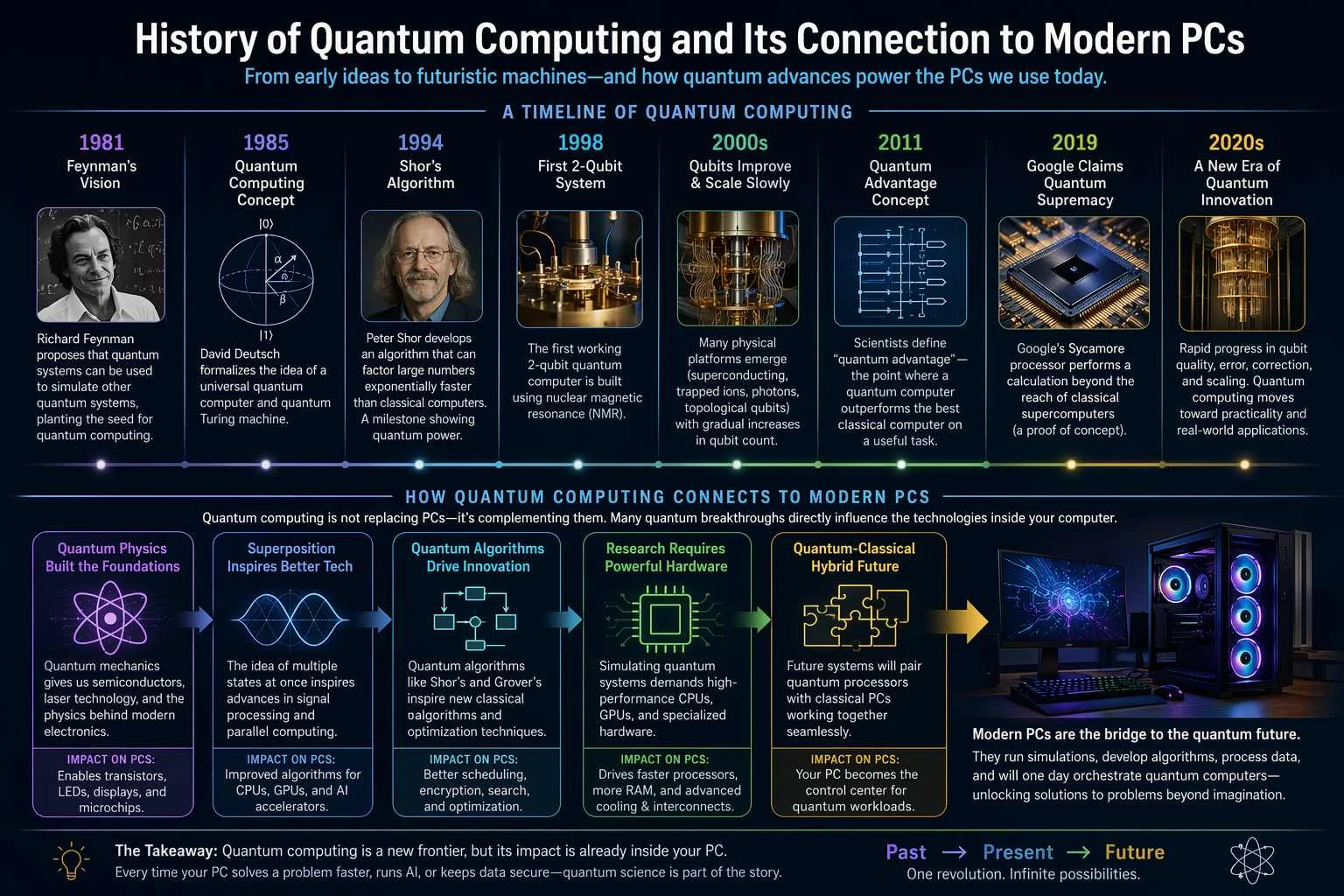
History of Quantum Computing and Its Connection to Modern PCs
Quantum computing is one of the most exciting technologies of the 21st century, but its roots go back much further than many people realize. Long before companies like IBM, Google, Microsoft, and Intel began building quantum processors, scientists were asking a simple but powerful question: Can computers use the laws of quantum physics to solve problems faster than traditional machines?
Today, quantum computing is often discussed alongside artificial intelligence, cybersecurity, cloud computing, and high-performance PCs. While quantum computers are not replacements for modern personal computers, they may become powerful partners for solving highly complex problems that classical computers struggle with.
In this article, we’ll explore the history of quantum computing, how it developed over time, and how it connects to the modern PCs we use every day.
What Is Quantum Computing?
Quantum computing is a new model of computing based on the principles of quantum mechanics, the branch of physics that explains how particles behave at extremely small scales.
Traditional computers, including desktops, laptops, and smartphones, use bits. A bit can be either a 0 or a 1. Quantum computers use quantum bits, or qubits, which can represent more complex states through quantum properties such as:
- Superposition – a qubit can exist in a combination of 0 and 1 states.
- Entanglement – qubits can become connected so that the state of one affects another.
- Quantum interference – quantum states can combine in ways that strengthen correct answers and reduce incorrect ones.
These principles allow quantum computers to approach certain problems differently than classical computers.
If you want a beginner-friendly comparison between quantum computing and artificial intelligence, read this guide: What Is the Difference Between AI and Quantum Computing?
Early Foundations: Quantum Mechanics Before Computing
The story of quantum computing begins with the birth of quantum mechanics in the early 20th century.
Scientists such as Max Planck, Albert Einstein, Niels Bohr, Werner Heisenberg, and Erwin Schrödinger developed ideas that changed physics forever. They discovered that particles like electrons and photons do not always behave like everyday objects. Instead, they follow probabilities, wave-like behavior, and strange interactions that classical physics could not explain.
At first, quantum mechanics had little to do with computers. It was mainly used to explain atoms, light, chemistry, and materials. However, these discoveries later helped create technologies that powered the modern computer age, including:
- Semiconductors
- Transistors
- Lasers
- Microchips
- Magnetic storage
- Modern electronics
In this sense, even today’s PCs are already connected to quantum physics. Without quantum mechanics, the transistors inside CPUs and GPUs would not exist.
Classical Computers and the Rise of Modern PCs
Before quantum computing became a serious research field, classical computers transformed the world.
Early computers in the 1940s and 1950s were huge machines used for military calculations, scientific research, and government projects. Over time, the invention of the transistor in 1947 and the integrated circuit in the late 1950s made computers smaller, faster, and more affordable.
By the 1970s and 1980s, personal computers began entering homes and offices. Companies such as Apple, IBM, Microsoft, and later Intel and AMD helped shape the PC revolution.
Modern PCs are based on the same fundamental idea as early computers: they process information using binary bits. However, today’s PCs are incredibly advanced compared to their ancestors. A modern laptop may contain billions of transistors, powerful multi-core processors, dedicated graphics chips, fast SSD storage, and AI acceleration features.
Still, no matter how powerful modern PCs become, they remain classical computers. They follow classical logic and process instructions step by step, even when using parallel processing.
The Birth of Quantum Computing Ideas
The idea of quantum computing began to take shape in the 1980s.
One of the key figures was physicist Richard Feynman. In 1981, Feynman argued that classical computers were inefficient at simulating quantum systems. Since nature itself behaves quantum mechanically, he suggested that a computer based on quantum rules might simulate nature more effectively.
Around the same time, Paul Benioff proposed a quantum mechanical model of a computer. Later, David Deutsch developed the concept of a universal quantum computer in 1985. Deutsch’s work helped establish quantum computing as a serious theoretical field.
These early ideas did not immediately produce working quantum computers, but they opened the door to a new kind of information science.
For more background, the IBM Quantum Computing overview is a useful external resource that explains how quantum computing is being developed today.
Quantum Algorithms Changed the Conversation
Quantum computing became much more famous in the 1990s because of two major algorithms.
The first was Shor’s algorithm, developed by mathematician Peter Shor in 1994. Shor’s algorithm showed that a powerful quantum computer could factor large numbers much faster than known classical methods. This was a big deal because much of modern internet encryption depends on the difficulty of factoring large numbers.
The second was Grover’s algorithm, introduced by Lov Grover in 1996. Grover’s algorithm showed that quantum computers could search certain types of databases faster than classical computers.
These discoveries proved that quantum computing was not just a strange physics idea. It had real implications for cryptography, cybersecurity, optimization, and computing theory.
To learn more about quantum information science, you can visit the National Institute of Standards and Technology quantum information page.
From Theory to Real Quantum Machines
Building real quantum computers has been extremely difficult. Qubits are delicate and easily disturbed by heat, vibration, electromagnetic noise, and other environmental factors. This problem is known as decoherence.
Researchers have explored several ways to build qubits, including:
- Superconducting circuits
- Trapped ions
- Photons
- Neutral atoms
- Quantum dots
- Topological qubits
In recent years, companies and research labs have made major progress. IBM, Google, IonQ, Rigetti, D-Wave, Microsoft, and others are actively developing quantum hardware and software.
In 2019, Google announced that its quantum processor had achieved a milestone often called “quantum supremacy,” meaning it performed a specific calculation faster than a classical supercomputer could under certain conditions. The claim sparked debate, but it showed that quantum computing had moved from theory into experimental reality.
You can explore Google’s quantum research at Google Quantum AI.
How Quantum Computing Connects to Modern PCs
Quantum computers and modern PCs are very different, but they are closely connected.
A quantum computer is not typically used by itself like a laptop or desktop. Instead, it usually works as part of a larger computing system that includes classical computers. Modern PCs and servers are needed to:
- Control quantum hardware
- Send instructions to quantum processors
- Interpret measurement results
- Run classical parts of hybrid algorithms
- Manage quantum software development
- Connect users to quantum cloud platforms
In other words, quantum computers still rely heavily on classical computing infrastructure.
Most people today access quantum computers through cloud services using ordinary PCs. A developer can write quantum programs on a laptop, send them to a cloud-based quantum processor, and receive results back through the internet.
This hybrid model is one of the most important connections between quantum computing and modern PCs.
Quantum Computing Will Not Replace Your PC
A common misconception is that quantum computers will replace regular computers. That is unlikely.
Modern PCs are excellent at everyday tasks such as:
- Browsing the web
- Writing documents
- Editing photos and videos
- Playing games
- Running business software
- Streaming media
- Software development
Quantum computers are not designed for these tasks. They are specialized machines that may eventually help solve certain categories of problems much faster than classical computers.
For example, quantum computing may be useful for:
- Drug discovery
- Materials science
- Chemical simulation
- Financial modeling
- Logistics optimization
- Cryptography research
- Climate modeling
- Machine learning acceleration
For a deeper look at what quantum computing may do in the future, visit: Quantum Computing and Future Applications
The Role of Classical PCs in Quantum Development
Modern PCs also play a major role in quantum education and software development. Programmers can use quantum development tools on classical computers to learn and test quantum algorithms.
Popular quantum programming platforms include:
These tools allow developers to simulate quantum circuits on classical machines before running them on real quantum hardware.
This means the PC remains an essential gateway into quantum computing. Students, researchers, and businesses can begin experimenting with quantum programming without owning a quantum computer.
Quantum Computing and the Future of PCs
As quantum technology matures, modern PCs may become more connected to quantum systems. We may see quantum cloud services integrated into development environments, AI platforms, cybersecurity tools, and scientific software.
In the future, a PC might send certain highly complex tasks to a quantum processor in the cloud, similar to how computers today offload tasks to GPUs or cloud servers. The user may not even notice that quantum computing is involved.
However, major challenges remain. Quantum computers need better error correction, more stable qubits, improved scalability, and practical applications that outperform classical systems in useful real-world tasks.
Still, progress is moving quickly. Governments, universities, and technology companies are investing billions of dollars into quantum research.
Conclusion
The history of quantum computing is a journey from early quantum physics to modern experimental machines. It began with scientists trying to understand nature at the smallest scales and grew into a new computing model that could transform industries.
Quantum computing is deeply connected to modern PCs. Classical computers were made possible by quantum physics, and today’s quantum systems depend on classical computers for control, programming, and cloud access.
While quantum computers will not replace laptops or desktops, they may become powerful companions to modern computing. The future will likely be hybrid: classical PCs, cloud systems, AI, and quantum processors working together to solve problems that were once impossible.
Quantum computing is still developing, but its history shows one thing clearly: the next major computing revolution may come from the strange and fascinating rules of the quantum world.


Leave a Comment