
Quantum Computing and Its Real World Applications in 2026
Introduction: Why Everyone Is Talking About Quantum Computing
Quantum computing sounds like something from a science fiction movie, but it is quickly becoming one of the most important technologies of the future. While it is still developing, researchers, governments, and major technology companies are already exploring how quantum computers can solve problems that are extremely difficult for today’s computers.
Traditional computers are powerful. They help us browse the internet, run businesses, manage bank accounts, stream videos, and power artificial intelligence tools. But some problems are so complex that even the fastest supercomputers struggle with them. These include simulating molecules, optimizing global supply chains, improving encryption, and modeling climate systems.
This is where quantum computing becomes exciting. Instead of working like normal computers, quantum computers use the laws of quantum physics to process information in a completely different way. Companies such as IBM Quantum, Google Quantum AI, and Microsoft Azure Quantum are already building platforms that allow researchers and businesses to experiment with this technology.
In this article, we will look at what quantum computing is, how it works, and the real world applications that could change industries in the coming years. My previous article outlines advantages in more detail here
What Is Quantum Computing?
It is a type of computing that uses principles from quantum mechanics, the science that explains how very small particles behave. These particles include atoms, electrons, and photons.
How Traditional Computers Work
A normal computer uses bits to store and process information. A bit can be either:
- 0
- 1
Everything your computer does, from opening a website to playing a video, is based on combinations of these 0s and 1s.
How Quantum Computers Work
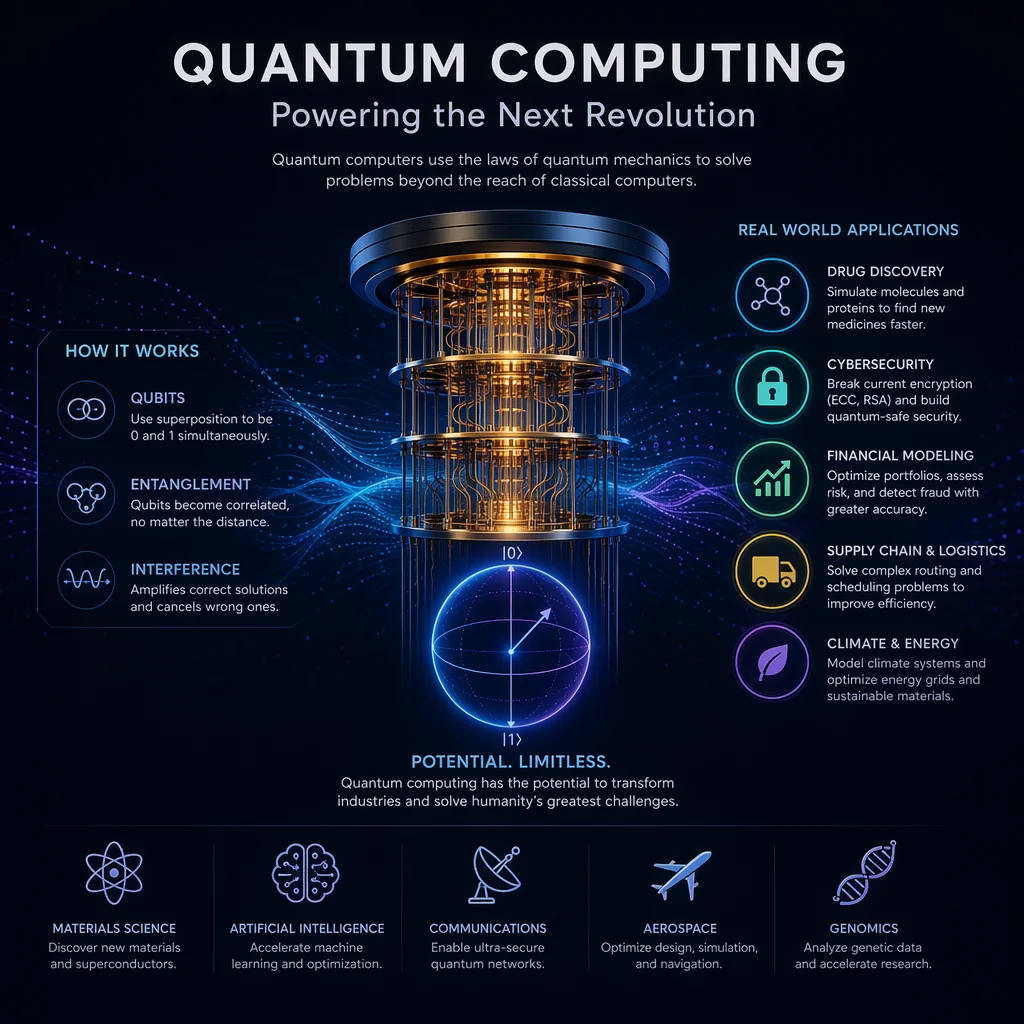
They use quantum bits, also called qubits. A qubit can be 0, 1, or both at the same time. This ability is called superposition.
That may sound strange, but it is one of the reasons quantum computing is so powerful. Instead of checking one possibility at a time, a quantum computer can explore many possibilities at once.
Another important concept is entanglement. When two qubits are entangled, they become connected in a special way. A change to one qubit can affect the other, even if they are far apart.
Quantum computers also use interference to increase the chances of reaching the right answer and reduce the chances of wrong answers.
Together, these features allow quantum computers to approach certain problems in a way that classical computers cannot.
Why Quantum Computing Matters
It matters because the world is becoming more complex. Businesses and scientists deal with huge amounts of data, complicated systems, and difficult calculations every day.
For example, imagine trying to find the best delivery route for thousands of trucks, or trying to simulate how a new drug will interact with the human body. These problems can involve millions or even billions of possible combinations.
Classical computers can solve many of these problems, but they may take a very long time. Quantum computing could help solve some of them faster and more efficiently.
It is important to understand that everyday computers will not be replaced. You probably will not use a quantum laptop to write emails or watch movies. Instead, quantum computers will likely be used for specialized tasks, often through cloud services.
Organizations such as the National Institute of Standards and Technology are also studying quantum technologies because they could affect cybersecurity, communications, and national security.
Real World Applications
We are still in its early stages, but many industries are already exploring its potential. Below are some of the most important real world applications of quantum computing.
Healthcare and Drug Discovery
Healthcare is one of the most promising areas for quantum computing. Developing new medicines is expensive, time-consuming, and risky. It can take many years and billions of dollars to bring a new drug to market.
Faster Drug Discovery
To create a drug, scientists need to understand how molecules behave and how they interact with proteins in the body. Molecules follow the rules of quantum mechanics, which makes them very difficult for classical computers to simulate accurately.
Quantum computers are naturally suited for this kind of work. In the future, they could help researchers simulate molecules more precisely and identify promising drug candidates faster.
Personalized Medicine
Doctors could one day use advanced models to understand how a treatment might work for a specific patient based on their genetics, medical history, and lifestyle.
This could lead to better treatment plans for diseases such as cancer, Alzheimer’s disease, and rare genetic conditions.
Finance
The finance industry depends on fast calculations, risk analysis, and prediction models. Banks, insurance companies, and investment firms are already interested in quantum computing because it could help them make better decisions.
Portfolio Optimization
Investors often need to choose the best combination of assets. They must consider risk, return, regulations, market changes, and economic uncertainty.
This creates a complex optimization problem. Quantum computing could help financial institutions analyze many possible investment combinations more efficiently.
Risk Management and Fraud Detection
Banks could use quantum algorithms to test different market scenarios and prepare for unexpected events.
In fraud detection, quantum-enhanced machine learning could help identify unusual patterns in financial transactions. This may make it easier to detect suspicious activity before serious damage is done.
Cybersecurity
Cybersecurity is one of the most talked-about areas in quantum computing. This is because they could both threaten and improve digital security.
The Risk to Current Encryption
Many of today’s encryption systems rely on mathematical problems that are hard for classical computers to solve. However, a powerful enough quantum computer could break some of these systems.
This is a serious concern for governments, banks, healthcare providers, and any organization that stores sensitive information.
Post-Quantum Cryptography
To prepare for this future, researchers are developing post-quantum cryptography. These are encryption methods designed to remain secure even against quantum computers.
The NIST Post-Quantum Cryptography Project is helping create standards for quantum-resistant security.
Quantum Key Distribution
Quantum key distribution, or QKD, uses quantum physics to detect if someone is trying to intercept a message.
If the system detects interference, users know the communication may not be secure.
Supply Chain and Logistics
Supply chains are complicated. Products may pass through factories, warehouses, ports, trucks, airplanes, and stores before reaching customers.
Better Route Planning
Companies need to move goods quickly while keeping costs low. Quantum computing could help find better delivery routes, reduce fuel use, and improve shipping schedules.
For example, a logistics company with thousands of vehicles may need to compare countless route options every day. With this tech we could help narrow down the best choices faster.
Managing Disruptions
Supply chains are often affected by weather, political events, labor shortages, and global delays. Quantum-powered optimization tools could help businesses respond more quickly when something goes wrong.
This would be especially useful for industries such as retail, manufacturing, food distribution, and e-commerce.
Artificial Intelligence
Artificial intelligence, or AI, already requires huge amounts of computing power. As AI models become more advanced, researchers are looking for new ways to process data faster and more efficiently.
Quantum Machine Learning
Quantum machine learning combines quantum computing with AI. It is still an emerging field, but it could eventually improve pattern recognition, data analysis, and prediction models.
Possible uses include:
- Medical diagnosis
- Image recognition
- Natural language processing
- Recommendation systems
- Cybersecurity monitoring
- Autonomous vehicles
Smarter Data Processing
Quantum computing may help AI systems analyze complex datasets that are difficult for classical computers to handle. This does not mean quantum AI will replace current AI soon, but it could become an important tool in the future.
Quantum Computing in Climate Science
Climate change is one of the most complex problems facing the world. Scientists use climate models to understand weather patterns, ocean temperatures, carbon emissions, and long-term environmental changes.
Better Climate Modeling
Climate models require huge amounts of data and computing power. We could improve these models by running complex simulations more efficiently.
Better climate models may help scientists predict extreme weather, study rising sea levels, and test possible climate solutions.
Clean Energy Innovation
For example, researchers may use quantum simulations to design:
- Better solar cells
- More efficient batteries
- Improved carbon capture materials
- Cleaner industrial processes
This makes quantum computing valuable not only for business but also for environmental sustainability.
Quantum Computing in Materials Science
Materials science focuses on creating new materials with useful properties. These materials are used in electronics, construction, transportation, energy, and healthcare.
Designing Better Materials
Scientists need to understand how atoms and molecules behave inside materials. This may lead to stronger metals, lighter aircraft parts, better computer chips, and more efficient batteries.
Manufacturing Improvements
Manufacturers could also use quantum computing to improve production processes. Better simulations and optimization tools may reduce waste, lower costs, and improve product quality.
In industries like aerospace, automotive, and electronics, even small improvements can make a big difference.
Challenges Facing Quantum Computing
Although quantum computing has huge potential, it is not ready for everyday use at a large scale.
Qubits Are Fragile
Qubits are extremely sensitive. Heat, vibration, and other environmental factors can cause errors. This problem is known as quantum noise.
To keep qubits stable, many quantum computers need special cooling systems and carefully controlled environments.
Error Correction Is Difficult
Quantum computers need advanced error correction to produce reliable results. Building systems that can correct errors while maintaining quantum behavior is one of the biggest challenges in the field.
Scaling the Technology
Today’s quantum computers have limited numbers of useful qubits. To solve major real world problems, scientists need to build larger and more stable machines.
Even so, progress is happening quickly. Cloud-based platforms now allow developers and researchers to test quantum algorithms without owning quantum hardware.
The Future of Quantum Computing
The future of quantum computing will likely be hybrid. This means quantum computers and classical computers will work together.
Classical computers will continue to handle everyday tasks, while quantum computers will focus on specialized problems such as optimization, simulations, cryptography, and advanced research.
Businesses do not need to become quantum experts overnight. However, they should start paying attention. Companies that learn about quantum computing early may be better prepared when the technology becomes more practical.
Industries such as healthcare, finance, energy, logistics, and cybersecurity are likely to be among the first to benefit.
One thought on “Quantum Computing and Its Real World Applications in 2026”
-
Pingback: Quantum Computing and Future Applications - Whiggsy FBA's blog


Leave a Comment